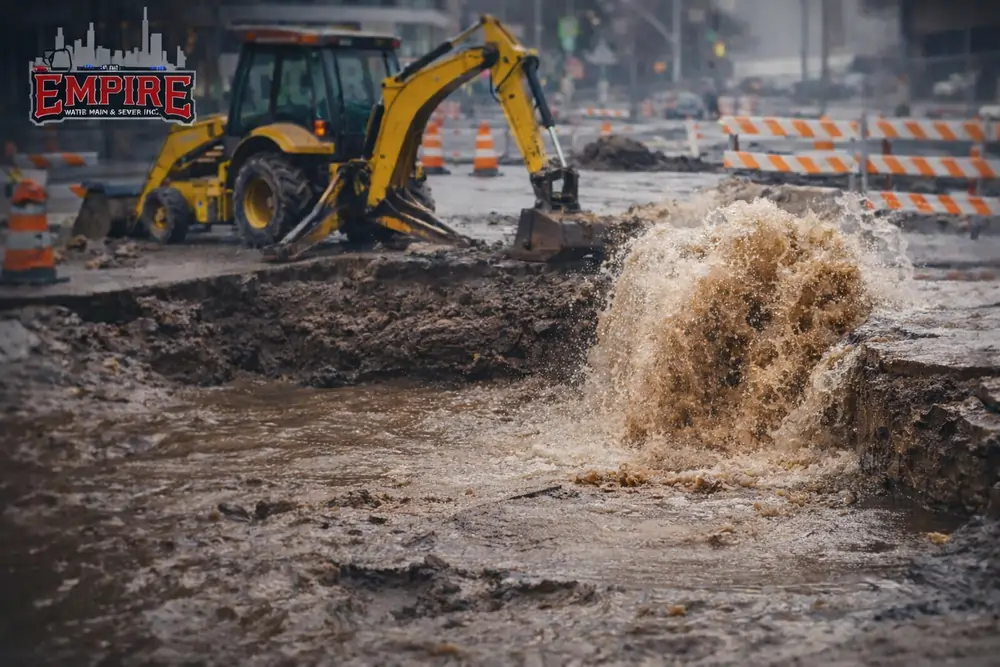
You turn on the tap and nothing comes out. Or you look outside and see water bubbling up through the sidewalk in front of your building. In New York City, a water main break is not a minor inconvenience — it can mean a DEP violation notice arriving within hours, a three-day repair deadline, and real financial exposure if you wait too long to act.
The first question most property owners ask is a simple one: how long will this take? At Empire Water Main & Sewer Inc, our water main repair crews work in all five boroughs every day. This guide gives you an honest timeline for every scenario, explains what slows repairs down in NYC specifically, and tells you exactly what to do while you wait.
Quick Answer: Most water main break repairs take between 4 and 8 hours once work begins. Complex breaks — those involving deep excavation, specialty parts, or multiple utility conflicts — can stretch to 2 or 3 days. In rare cases, major infrastructure failures affecting large sections of pipe take a week or more. In New York City, private service line repairs must begin within 3 business days of a DEP notice.
City Water Main vs. Your Private Service Line: Who Fixes What?
This is the question that determines everything — who pays, who calls whom, and how fast the repair happens. In New York City, the water system has two distinct ownership boundaries, and they sit right at your property line.
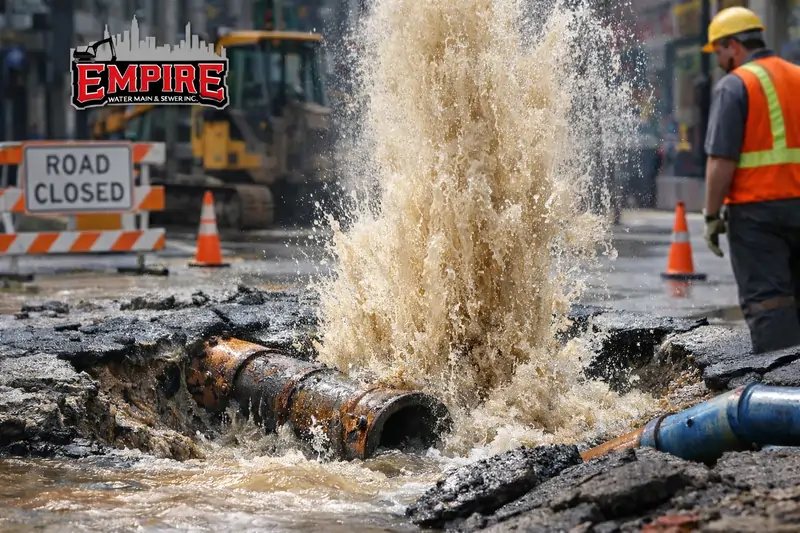
The city owns the large water mains running beneath the streets. New York City delivers roughly one billion gallons of water daily through approximately 6,800 miles of underground pipes, many of which are more than 100 years old. When those city-owned mains fail, the NYC Department of Environmental Protection (DEP) is responsible for the repair. You call 311, the city investigates, and the city fixes it — though not always as fast as you would like.
Your responsibility starts at the city connection and runs all the way to your building. If the DEP determines the break originates on your private service line, they issue a formal Three-Day Notice to Repair. That notice requires you to hire a licensed master plumber and complete the repair within three business days. Miss that deadline and face fines, potential water shutoff, and city-imposed repair costs that far exceed what a private contractor would charge.
How to Tell Which Side of the Line Is Broken
- Water bubbling up at or beyond your property line toward the street: likely city main
- Water pooling in your yard, basement, or near your foundation: likely your service line
- Your neighbors have full water pressure but yours is gone: usually your private line
- The entire block or multiple buildings have lost pressure: city main failure
- You received a DEP violation notice: your service line is confirmed as the source
- Your water meter is spinning when all fixtures are off: active leak on your line
When in doubt, call a licensed contractor before calling 311. A trained eye can identify which side of the line is leaking, sometimes without any excavation at all. Calling the city first and then discovering the break is on your side wastes valuable time when you are working against a three-day deadline.
Water Main Break Repair Timeline: What to Expect at Each Stage
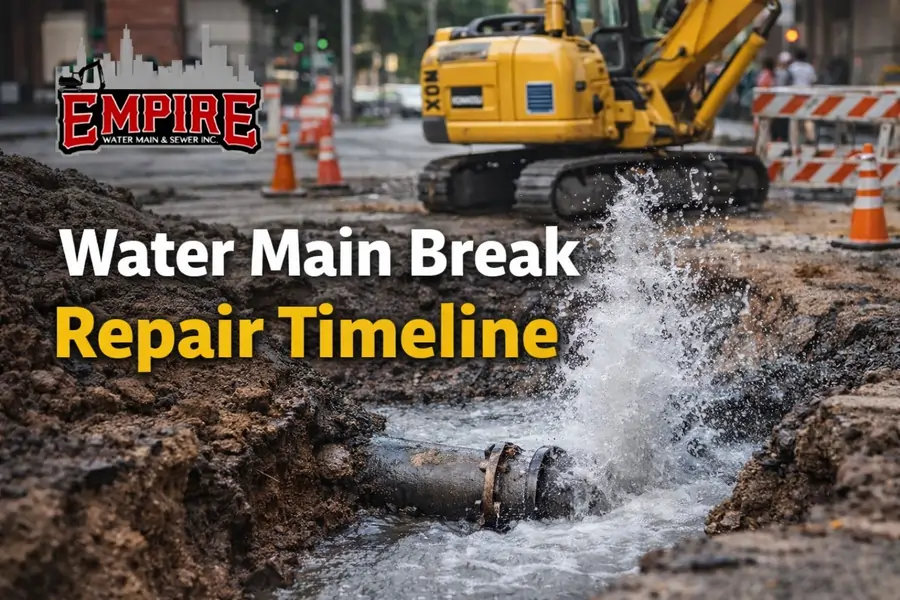
Whether the city is handling the repair or you are managing a private service line fix, the repair follows a predictable sequence. Understanding each stage helps you set realistic expectations — and push back if something is taking longer than it should.
Stage 1: Detection and Dispatch (0 to 2 Hours)
For city main breaks, this clock starts when someone calls 311 or the DEP command center receives an alert. An investigator is dispatched to confirm the break, assess severity, and classify it as an emergency or scheduled repair. Breaks affecting many customers, creating road flooding, or threatening infrastructure get prioritized. Others join a queue.
For private line breaks, this stage starts with your call to a licensed contractor. A reputable team arrives within one to two hours for emergency situations. They locate the curb stop valve, shut off flow if possible, and assess whether the leak is at a specific point or throughout the line.
Stage 2: Permitting and Utility Marking (1 to 24 Hours)
Before any excavation starts, permits must be pulled. In NYC, water main work beneath a public sidewalk or street requires both DEP and DOT permits. Our team handles all DEP permit filings as part of the repair process so you are not chasing paperwork while your water is off. Utility marking — required by law before any digging — adds another variable. The utility marking service must be notified, a technician must visit the site, and all underground lines must be flagged before a shovel touches the ground. This step alone can add several hours to a full day in dense urban areas.
Stage 3: Excavation (2 to 6 Hours)
Once the site is cleared and permitted, equipment moves in. Excavation in New York City is never simple. Streets in Manhattan, Brooklyn, Queens, the Bronx, and Staten Island are layered with gas lines, electric conduits, telecom cables, and other water and sewer infrastructure. Crews often have to hand-dig around gas and electric lines rather than using mechanical equipment, which slows the process significantly.
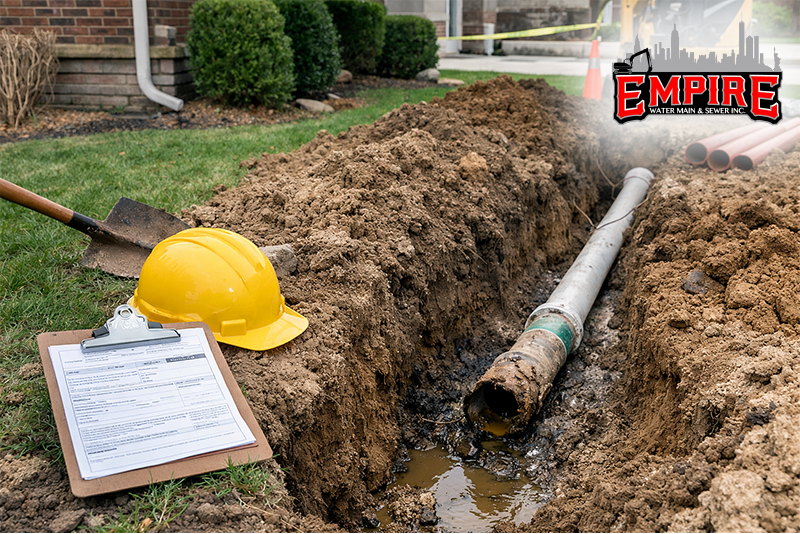
For private service line repairs, excavation typically opens a section of sidewalk, driveway, or yard to expose the pipe. Depth varies — most NYC service lines run between 4 and 6 feet below grade, and some run deeper depending on building age and frost line requirements.
Stage 4: Pipe Repair or Replacement (1 to 4 Hours)
Once the break is exposed, the actual repair is often the fastest part of the entire process. A small crack or pinhole leak in an accessible section of pipe can be repaired with a clamp or coupling in under an hour. A full section replacement — cutting out the damaged pipe and splicing in new material — takes longer but is still typically completed within a few hours under normal conditions.
Complications arise when the existing pipe material is no longer available, when the break has caused surrounding soil to become unstable, or when multiple failure points are discovered once the pipe is exposed. In those cases, a full water main replacement is the right call rather than patching a line that will fail again.
Stage 5: Pressure Testing, Flushing, and Restoration (2 to 6 Hours)
After the pipe is repaired, water cannot simply be turned back on. In New York, each repaired or new service connection must pass a pressure test conducted with a DEP inspector present. Once the line passes, it is flushed to clear sediment and air pockets. This process takes two to four hours in most residential scenarios.
Street and sidewalk restoration follows. NYC DOT requires that any disturbed pavement be restored to pre-existing condition. Temporary patching happens immediately; permanent pavement restoration may be scheduled separately depending on the season and material availability. Permanent asphalt restoration cannot be performed during freezing temperatures, which is worth knowing if your break happens in January.
Water Main Break Repair Time by Scenario
Every repair is different. Here is a realistic timeline breakdown based on the most common scenarios Empire Water Main & Sewer Inc handles across New York City:
| Scenario | Typical Repair Time | Key Variable |
| Simple clamp or coupling repair, accessible pipe | 4 – 6 hours | Permit speed, utility marking |
| Private service line section replacement | 6 – 10 hours | Excavation depth, pipe material |
| Full private service line replacement | 1 – 2 days | Line length, permitting, DEP inspection |
| City main break (standard size, residential street) | 6 – 12 hours | Priority classification, crew availability |
| City main break (major artery or large diameter pipe) | 1 – 5 days | Specialty parts, traffic management |
| Break requiring specialty parts not in stock | 2 – 7+ days | Supplier lead time |
| Emergency shutdown + temporary fix + permanent repair | 2 – 4 days total | Two-stage process |
| Major infrastructure failure (multiple blocks affected) | 1 week or more | Scope of damage, city coordination |
6 Factors That Slow Down Water Main Repairs in New York City
1. Depth and Soil Conditions
Deeper pipes take longer to reach. In older New York neighborhoods, some water mains run 6 to 10 feet below grade. If the surrounding soil has been destabilized by the water leak itself — which happens when water has been flowing for hours before detection — crews must shore the excavation before working, adding significant time.
2. Utility Conflicts
New York City’s subsurface is one of the most congested underground environments in the world. Gas lines, electric conduits, fiber optic cables, subway infrastructure, and other water and sewer pipes all occupy the same narrow corridor beneath streets and sidewalks. When a water main runs directly adjacent to a gas main, hand excavation is required around both, which is slower and more labor-intensive than mechanical digging.
3. Parts Availability
Not all pipe fittings and couplings are in stock at every contractor’s yard. Older cast iron mains in pre-war New York buildings sometimes require fittings that are no longer manufactured, forcing crews to source custom or adapted parts. That sourcing process can add one to several days to an otherwise straightforward repair.
4. Weather
Cold weather creates two separate problems. First, it increases the frequency of breaks — as ground temperatures drop, soil contracts and puts additional stress on aging pipes. Second, frozen ground is slower to excavate and harder to work in safely. Winter repairs in New York also cannot receive permanent pavement restoration until temperatures rise, so repairs done between November and March often leave temporary patches that are addressed the following spring.
5. Time of Day and Traffic
Work on major arterial roads in New York often cannot proceed during peak traffic hours. A repair on a Manhattan avenue or a busy Brooklyn commercial street may need to begin late at night or in the early morning to comply with DOT work-hour restrictions. That scheduling constraint can add a full day to the overall timeline even when all materials and permits are ready.
6. Scope Discovered During Excavation
What looks like a single crack from the surface is sometimes a longer failure pattern once the pipe is exposed. A repair that starts as a clamp job becomes a section replacement when the excavating crew finds that three feet of pipe have deteriorated. Experienced contractors build contingency into their timelines, but surprises underground are part of water main work in an aging city.
What to Do Right Now If Your Water Main Is Broken
While the repair timeline is outside your control once work starts, what you do in the first hour matters. These steps protect your property and speed up the overall process.
- Locate and close your main shutoff valve — This is usually in your basement or mechanical room near where the water line enters the building. Closing it stops water from flowing into your property and prevents internal pipe damage.
- Check your curb stop valve — In NYC, a curb stop valve sits near your property line and can be closed with a specialized key. Closing this stops water flowing from the city connection into your line. Do not attempt to close this yourself if you have not done it before — call a licensed contractor.
- Document the leak — Take photos and video of where water is surfacing, any property damage, and the condition of the surrounding sidewalk and street. This documentation supports any insurance claims and helps your contractor assess the situation before arriving.
- Call a licensed contractor immediately — In NYC, water main repair can only be performed by a company with a Licensed Master Plumber on staff. Do not hire an unlicensed crew, regardless of cost. DEP violations require licensed plumber sign-off.
- Call 311 if you suspect city main involvement — If your neighbors are also without water, or if water is surfacing from the street itself, report it to 311. This puts the city on notice and starts their response clock.
- Prepare for water disruption — Fill bathtubs, pots, and any containers you have. Even if your water comes back on in a few hours, having a supply on hand covers you if there are delays.
The NYC DEP Three-Day Notice: What It Means and What Happens If You Miss the Deadline
When the DEP confirms that a water main break originates on your private service line, they issue a formal Three-Day Notice to Repair. This is not a courtesy reminder — it is a compliance order with real consequences.
You have three business days to hire a licensed master plumber, pull the required permits, complete the repair, and have it inspected. If you miss that window, the DEP can shut off your water without further notice and bill you for the shutoff — a cost that runs $1,000 or more before any repair work begins. For situations where the leak is causing flooding or structural damage, the DEP may act in less than 24 hours. That is when emergency water main repair is not optional — it is the only viable response.
Common Reasons Properties Miss the Three-Day Deadline
- Waiting too long to call a contractor after receiving the notice
- Hiring an unlicensed contractor who cannot pull the required DEP permits
- Underestimating permit processing time and failing to apply on day one
- Discovering during excavation that a full line replacement is needed rather than a spot repair
- Parts delays for older pipe materials not commonly stocked
The fastest way to protect yourself against deadline violations is to call a licensed contractor the moment you receive or suspect a DEP notice is coming. Empire Water Main & Sewer Inc handles permit applications, DEP coordination, and all repair work under one licensed roof so nothing falls through the cracks.
City Main Break vs. Private Service Line Repair: A Side-by-Side Comparison
| Factor | City Water Main Break | Private Service Line Break |
| Who is responsible | NYC DEP and city crews | Property owner |
| Who pays for repairs | City of New York | Property owner |
| Response time | Priority-based, hours to days | Your contractor, 1–2 hours |
| Permit requirement | City handles internally | Owner must obtain DEP + DOT permits |
| Typical repair time | 6–12 hours (standard) | 6–24 hours (standard) |
| Deadline to act | City sets timeline | 3 business days from DEP notice |
| Sidewalk restoration | City responsibility | Owner must restore to prior condition |
| Who to call first | 311 | Licensed master plumber contractor |
Signs Your Water Service Line Was Already Failing Before the Break
Most water main breaks do not happen without warning. The pipe usually shows symptoms weeks or months before the failure becomes visible at the surface. Recognizing these signs early gives you the option to repair on your schedule rather than under a three-day compliance order.
- Chronically low water pressure throughout the building that has worsened over time
- Discolored or rust-tinted water, especially first thing in the morning
- Wet or unusually soft patches of soil in your yard with no rain explanation
- Higher-than-normal water bills with no change in usage
- Rumbling, hissing, or banging sounds in pipes when water is running
- Foundation cracks or settling near the service line entry point
- Water pooling at the base of your basement walls after dry weather
If your building is showing any of these signs, a diagnostic inspection is worth scheduling now. Proactive water main repair on your own timeline is significantly less expensive and disruptive than an emergency repair under a DEP deadline. It also protects you from the cascading costs of water damage to your foundation, walls, and basement.
Water Main Repair vs. Full Replacement: Which Does Your Property Need?
Not every water main break calls for full replacement. And not every repair is worth making when the pipe is near the end of its service life. Here is how to think through the decision.
When a Targeted Repair Makes Sense
- The pipe is generally in good condition and the failure is isolated to a single point
- The pipe material is still appropriate for the application (copper, ductile iron, or modern plastic)
- The break was caused by a specific external event like nearby construction or frost heave, not systemic corrosion
- The remaining pipe shows no significant corrosion, pinholing, or joint deterioration on camera inspection
- The pipe is less than 30 years old and has not had prior repairs
When Full Replacement Is the Better Call
Some pipes have simply lived their useful life. Cast iron service lines installed before 1960 are now routinely 60 to 80 years old. Once a line starts failing at one point, other sections are typically close behind. If a camera inspection shows widespread corrosion, multiple offset joints, or prior repair patches throughout the line, full replacement is almost always more cost-effective than repeated spot repairs. Our water main installation team replaces the full service line with modern materials — typically copper or high-density polyethylene — sized correctly for the building’s current demand.
Why New York Property Owners Call Empire Water Main & Sewer Inc
Empire Water Main & Sewer Inc is a licensed master plumber company serving New York City’s five boroughs. We handle water main repairs, replacements, emergency response, and DEP compliance work every day. Our team knows the city’s permit process, the borough-specific requirements for sidewalk restoration, and the underground infrastructure quirks that make New York City different from anywhere else.
When you call us for a water main break, we arrive ready to work — not to assess and quote and schedule for next week. We pull permits, coordinate with the DEP and DOT, perform the repair, conduct the pressure test with the inspector on-site, and restore the work area before we leave.
If you are dealing with a water main break right now, or if you received a DEP notice and the clock is running, contact our team immediately. We are available for emergency response across all five boroughs and will give you a straight answer on timeline, cost, and what to expect before any work begins.
Frequently Asked Questions About Water Main Break Repair Times
How long does it take to fix a water main break?
Most water main break repairs take between 4 and 8 hours from the time work begins. Simple repairs on accessible pipe in good condition finish toward the lower end of that range. Repairs requiring deep excavation, specialty parts, or extensive utility conflict resolution can run 10 to 24 hours or more. Repairs on large-diameter city mains in high-traffic areas sometimes take 2 to 5 days.
How long will I be without water during a water main repair?
For private service line repairs in New York City, expect water to be off for 4 to 8 hours for a standard repair. The water must remain off through the pressure test with the DEP inspector and the initial flushing period. For city main breaks, the water outage typically lasts 4 to 12 hours for standard breaks, though complex repairs can extend the outage to 24 hours or longer.
What is the NYC DEP Three-Day Notice to Repair?
When the NYC DEP identifies a water main leak originating on your private service line, they issue a formal Three-Day Notice requiring you to hire a licensed master plumber and complete repairs within three business days. Failure to comply can result in water shutoff, fines exceeding $1,000, and city-imposed repair costs charged back to the property owner. The DEP is responsible for confirming the source of the leak; if you believe the notice was issued in error, a licensed contractor can help you file a challenge.
Can I fix a water main break myself in New York City?
No. Water main repair and replacement in New York City requires a Licensed Master Plumber on staff. This applies to all work on private service lines from the building to the city connection. Unlicensed repair work will not pass the required DEP pressure inspection and can result in additional violations. The DEP also requires that permit applications be filed by a licensed master plumber.
What causes water main breaks in New York City?
The most common causes are pipe age and corrosion — a large share of NYC’s underground water infrastructure is over 80 years old. Temperature swings cause the ground to expand and contract, stressing older cast iron pipes that have lost flexibility. Nearby construction vibration, ground settlement, and electrolytic corrosion from contact with other underground metals are also frequent contributors. The American Society of Civil Engineers estimates that roughly 240,000 water main breaks occur annually across the United States.
Is the city responsible for fixing the water main break near my property?
It depends on where the break is. The city owns the water main running beneath the street. You own the service line running from the city connection to your building. If water is surfacing from the street and your neighbors are also affected, the city main is likely the source — call 311. If the issue is isolated to your property, your service line is the probable source, and the repair is your financial responsibility.
Does homeowners insurance cover water main break repairs in NYC?
Standard homeowners policies typically do not cover the repair of the private water service line itself, though some policies offer service line coverage as a rider or endorsement. Water damage caused inside your home by a main line break may be covered under your policy’s water damage provisions, depending on the cause and your specific policy terms. Review your policy or call your agent before assuming coverage exists.
What should I do immediately when I discover a water main break?
First, shut off your main house valve to stop water from flowing into your building. Then check your curb stop valve if you know where it is and how to operate it. Document the leak with photos and video. Call a licensed water main contractor for an emergency assessment. If water is surfacing from the street or your neighbors are also losing pressure, report to 311 as well. Do not wait to see if the problem resolves on its own — water main leaks do not self-seal.
The Bottom Line on Water Main Break Repair Time in New York
A standard water main break repair in New York City takes between 4 and 24 hours once work begins. The overall timeline from the moment you discover the break to the moment your water is back on reliably is often one to two full days when you account for permitting, utility marking, excavation, repair, testing, and restoration.
What extends that timeline is almost always preventable: waiting too long to call a contractor, hiring an unlicensed crew who cannot pull permits, or discovering that a pipe in poor condition needs full replacement rather than a targeted fix. The property owners who get through this fastest are the ones who call a licensed contractor first and let that contractor drive the process.
If your property has both water main and sewer line issues — which is common in older New York buildings where both systems are reaching the end of their service life simultaneously — addressing them together during one excavation is significantly more efficient than scheduling separate projects. Ask our team about combined scope repairs when you call. Empire Water Main & Sewer Inc is available for emergency water main response across all five boroughs. Contact us the moment you suspect a break — the sooner work starts, the sooner your water is back on and the DEP clock stops running.