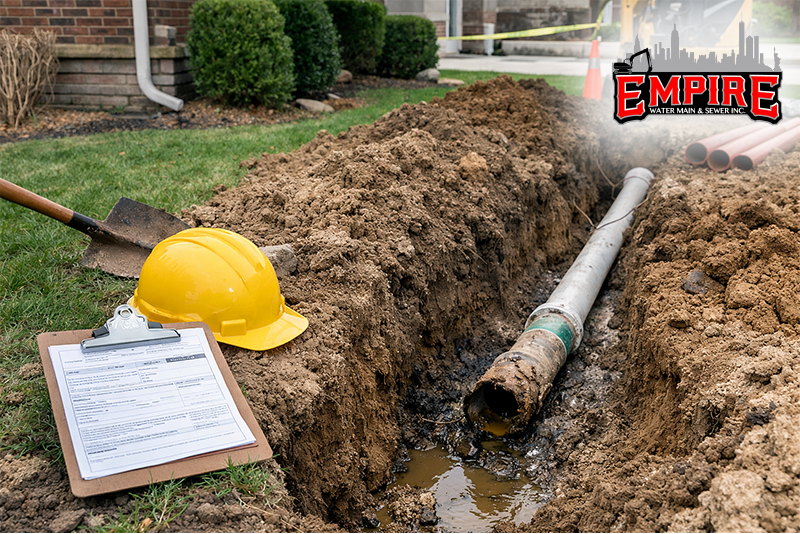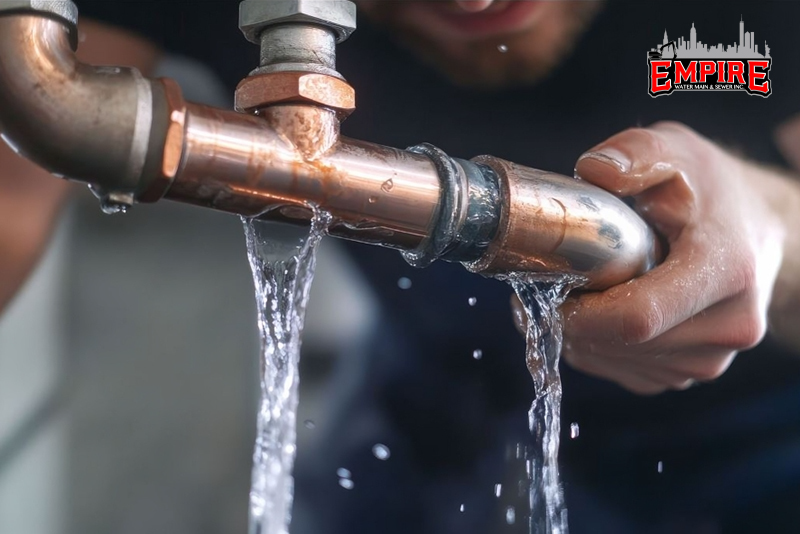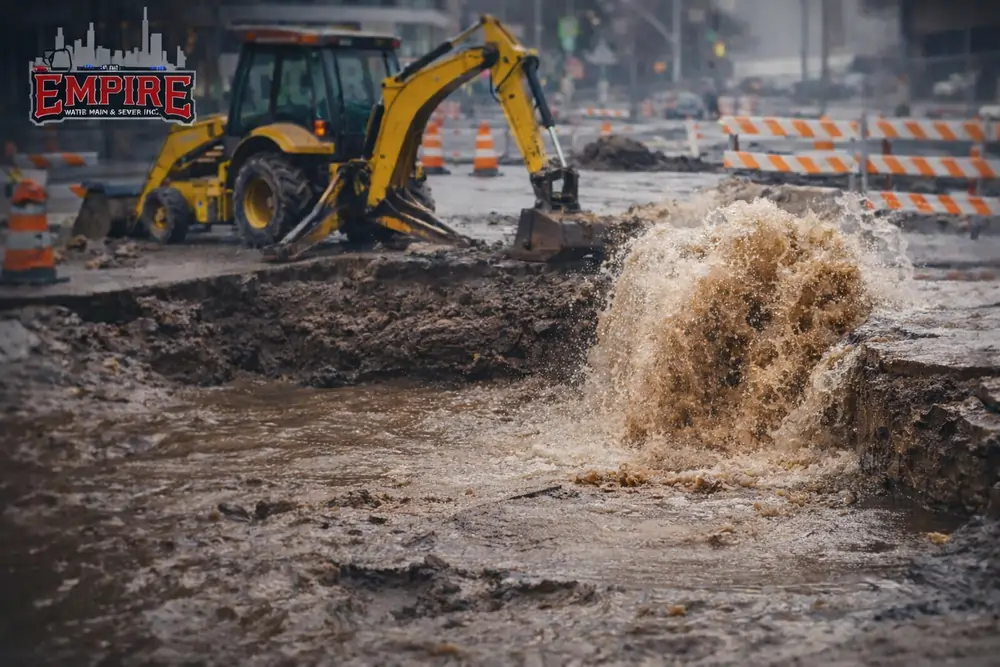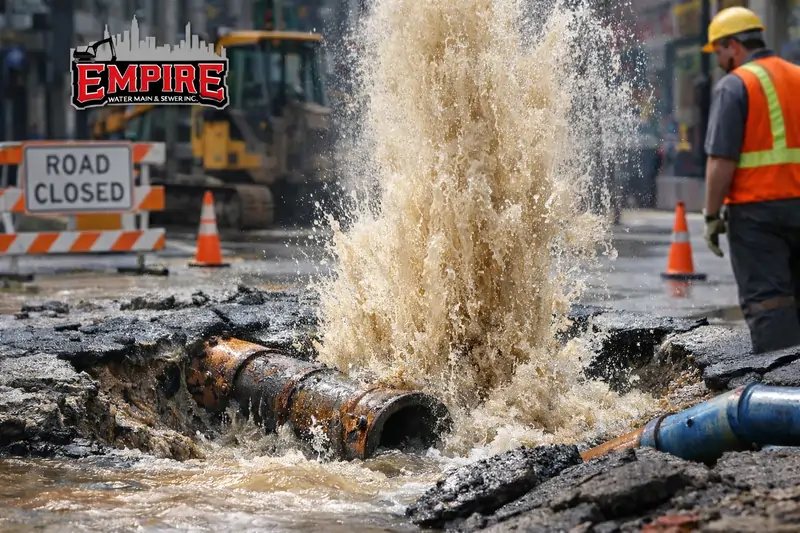
At least one water main breaks every single day in New York City. Some of those breaks make the news — like the 120-year-old pipe that flooded Times Square and shut down subway lines. Most do not. They surface quietly as a wet patch on a sidewalk, a rumble in the walls, or a spike in a water bill that takes weeks to trace back to a failing service line under the property.
Understanding what causes water main breaks matters for two reasons. First, some causes are predictable and give you time to act before a full failure occurs. Second, if you know what caused your break, you can address the root condition — not just patch the pipe and wait for it to happen again. At Empire Water Main & Sewer Inc, we repair and replace water mains across all five New York City boroughs. The causes we see most often are consistent, and most of them are traceable to specific conditions in the city’s infrastructure and environment.
This guide covers every significant cause of water main failure, explains how each one damages pipe specifically, and tells you what the warning signs look like before a break becomes an emergency. If you are already past the warning stage, our water main repair team is available across all five boroughs for same-day emergency response.
Quick Answer: The most common causes of water main breaks in New York City are pipe age and material deterioration, freeze-thaw ground movement, corrosion and electrolysis, water pressure fluctuations, nearby construction, tree root intrusion, soil erosion and ground settlement, water hammer, and manufacturing or installation defects. In NYC specifically, aging cast iron infrastructure — much of it over 80 years old — is the single biggest underlying factor in most failures.
Why New York City Has More Water Main Breaks Than Most Cities
New York City’s water system delivers roughly one billion gallons of water daily through approximately 6,800 miles of underground mains. The average age of those mains is estimated at 85 years or older in many neighborhoods, with some pipes still in active service that were installed in the late 1800s. The pipe that flooded Times Square in 2023 dated to 1896.
Over two-thirds of the city’s water mains are made from unlined or cement-lined cast iron — a material that becomes progressively more brittle as it ages and that handles temperature-driven expansion and contraction poorly. Roughly 40 percent of all NYC water mains were installed before 1941, and at the current replacement pace, it would take over 100 years to swap out the oldest pipes in the system.
Private service lines — the pipes that run from the city main to individual buildings — often match or exceed the age of the street-side infrastructure. In pre-war brownstones, rowhouses, and apartment buildings across Brooklyn, Queens, the Bronx, and Manhattan, service lines installed 70 to 100 years ago are still in service today. That age factor sits underneath nearly every cause discussed in this article.
9 Causes of Water Main Breaks in New York City
1. Pipe Age and Material Deterioration
Age is the root cause behind most water main failures. No pipe material lasts forever, and the rate of deterioration depends heavily on what the pipe is made from, what it carries, and what surrounds it underground.
Cast iron, the dominant material in pre-1980 New York City water infrastructure, loses structural integrity as it oxidizes. Over decades, the internal surface corrodes and the pipe wall thins. What was installed at a wall thickness designed to handle decades of water pressure gradually becomes a shell that fractures under the same conditions it handled easily in its early years.
| Pipe Material | Typical Lifespan | Failure Risk After Lifespan | Common in NYC Since |
| Unlined cast iron | 50–70 years | Very high — internal corrosion and brittleness | Pre-1940 |
| Cement-lined cast iron | 60–80 years | High — cement lining delays but does not prevent failure | 1940–1980 |
| Ductile iron | 80–100 years | Moderate — more flexible than cast iron | 1970s–present |
| Copper (service lines) | 50–70 years | Moderate — vulnerable to electrolysis in NYC | 1950s–present |
| HDPE / PVC | 100+ years | Low — resistant to corrosion and temperature stress | 2000s–present |
| Galvanized steel | 40–60 years | Very high — rust and internal buildup | Pre-1950 |
When a pipe exceeds its design lifespan, any additional stressor — a cold night, a pressure surge, nearby construction — can be enough to trigger a failure that a younger pipe would have absorbed without consequence. This is why breaks tend to cluster in older neighborhoods and on blocks where the infrastructure has never been replaced.
2. Freeze-Thaw Cycles and Ground Movement
New York City winters create a specific and highly damaging pattern for underground pipes. When temperatures drop below freezing, the soil surrounding buried pipes contracts. When temperatures rise again — sometimes within the same week — that soil expands. This freeze-thaw cycling puts directional stress on pipes, particularly at joints, elbows, and any section where the pipe transitions in material or diameter.
Water expands by approximately 9 percent in volume when it freezes. If water inside a pipe or in the surrounding soil freezes, that expansion creates outward pressure that brittle cast iron cannot absorb. The pipe cracks, often at its weakest point — a joint, a pre-existing corrosion spot, or a location where prior construction disturbed the bedding material around the pipe.
This is why water main breaks spike dramatically in January and February in New York City and drop during the stable months of spring and early fall. A sudden cold snap after a warm stretch is particularly dangerous, because the rapid temperature change creates larger differential stress than a gradual seasonal transition would.
3. Corrosion from Soil Chemistry
Not all soil is neutral. The ground beneath New York City streets contains varying concentrations of chlorides, sulfates, and organic acids that react with metal pipe surfaces over time. Soil with high salt content — common near coastal areas in the outer boroughs — accelerates the oxidation of cast iron. Soil near former industrial sites may contain chemical compounds that actively attack pipe coatings and metal surfaces.
Corrosion works from the outside in on buried metal pipes. The outer wall pits and thins. Pinhole leaks develop first, often going undetected for months because the surrounding soil absorbs the seeping water before it surfaces visibly. By the time a break becomes visible at the surface, the pipe may have been losing water and structural integrity for a year or more.
Internal corrosion occurs simultaneously on unlined cast iron pipes, where the water itself — slightly acidic in some pH conditions — attacks the pipe wall from the inside. The combination of external soil corrosion and internal water corrosion is what accelerates the lifespan reduction of older NYC mains beyond what age alone would predict.
4. Electrolysis and Galvanic Corrosion (A Distinct NYC Problem)
Electrolysis is one of the most misunderstood and underappreciated causes of water main failure in New York City. It is also one of the most destructive, because it can destroy a brand-new copper service line in as little as one to three years — and most property owners never see it coming until the pipe has already failed.
Electrolysis occurs when stray direct current (DC) electricity traveling through underground infrastructure contacts metal water pipes. New York City’s dense subsurface — packed with subway electrical systems, utility conduits, and decades of overlapping infrastructure — generates significant stray current. When that current passes through a copper service line, it drives an electrochemical reaction that literally dissolves the pipe wall from the inside out, creating pitting patterns that eventually perforate the pipe.
Galvanic corrosion is a related but distinct problem. It occurs when two dissimilar metals — copper and cast iron, for example — come into direct underground contact. The less noble metal acts as a sacrificial anode and corrodes preferentially. In NYC, where copper service lines frequently connect to older cast iron city mains, this contact point is a common source of accelerated failure.
The practical consequence for New York property owners is significant. A building with repeated water main failures — especially if the pipe was recently replaced and failed again within a few years — is likely experiencing electrolysis damage. Without installing protective sleeving or dielectric couplings on the replacement line, the new pipe will fail just as fast as the old one.
5. Water Pressure Fluctuations and Water Hammer
Water mains operate under sustained pressure. In New York City, residential water pressure typically runs between 40 and 80 psi, with higher pressures in some areas depending on elevation and system design. That constant pressure is something a structurally sound pipe handles without issue.
The problem is pressure change. Rapid pressure fluctuations — caused by sudden valve closures, fire hydrant openings, or surges in system demand — create shock waves inside the pipe. The phenomenon is known as water hammer, and it produces brief but extremely intense pressure spikes that can reach several times the normal operating pressure. A cast iron pipe with pre-existing corrosion spots or thin wall sections may crack under the stress of a pressure spike that a sound pipe would absorb.
Water hammer damage often looks like a sudden catastrophic failure with no apparent warning — the pipe was fine yesterday and flooded the street today. In reality, the pipe had been weakening for months or years before the pressure event delivered the final stress. When that happens on a private service line, it typically triggers a DEP notice and puts a property owner on a three-day emergency repair deadline. Acting fast is the only way to avoid water shutoff and mounting fines.
6. Nearby Construction and Excavation Damage
New York City is constantly under construction. Subway extensions, building foundations, utility upgrades, road repaving, and private excavation projects all disturb the soil around existing underground pipes. That disturbance is a direct and frequent cause of water main breaks.
Heavy excavation equipment can strike a water main directly — even with utility marking completed, GPS coordinates and field markings have margin for error, and older pipes may not be mapped accurately. More subtle is the indirect damage: excavation adjacent to a water main removes the surrounding soil that provides bedding support, leaving the pipe in a structurally unsupported position. That unsupported span then flexes under traffic loads and ground movement until it fails at the weakest point.
Vibration from heavy construction equipment is another vector. Extended drilling or pile-driving near an aging cast iron main can fracture a pipe that was marginal before the construction began. This type of damage is particularly difficult to trace because the pipe may not fail until days or weeks after the nearby work is complete.
7. Tree Root Intrusion
Tree roots are a more significant factor in water main failure than most property owners realize. Root systems extend three to five times the diameter of the tree’s canopy, often reaching 50 to 100 feet from the trunk. As roots grow and expand year over year, they exert consistent radial pressure on any pipe they contact underground.
For older cast iron or clay pipes with joints that have shifted slightly over time, root intrusion begins at those joint gaps. The roots enter through the smallest openings — sometimes just a hairline crack — and then expand inside the pipe, progressively widening the break while simultaneously reducing flow. By the time a root-related failure becomes visible at the surface, the pipe interior often looks like a root ball.
In New York City, street trees planted in sidewalk beds directly above service lines are a common culprit. Mature London plane trees, pin oaks, and silver maples — the dominant species in NYC’s urban forest — develop aggressive root systems that reach well beneath the depth of standard service lines. Properties with large mature trees immediately adjacent to the building’s water service entry point should consider this a risk factor worth inspecting proactively.
8. Soil Erosion and Ground Settlement
Water mains depend on the soil around them for structural support. When that soil erodes or settles unevenly, the pipe is left spanning a void — and unsupported spans fail under load stress, thermal movement, and vibration in ways that bedded pipes do not.
Soil erosion around water mains has two primary sources. First, a pre-existing small leak in the pipe itself gradually washes away the surrounding soil, creating a progressively larger void that ultimately causes the pipe to fail catastrophically when the void reaches a critical size. Second, external water movement — heavy rain, storm drain overflow, or an adjacent utility leak — can wash out the bedding material beneath a pipe without any failure in the pipe itself.
Ground settlement is particularly problematic in areas built on fill material, which is common along the shorelines of Brooklyn, Queens, and Staten Island. Fill-based soil compresses unevenly over time, creating differential settlement that stresses pipes at the transition between settled and unsettled sections. This shear stress produces circumferential cracks — breaks that wrap around the pipe rather than running along it.
9. Manufacturing Defects and Installation Errors
Not every water main failure traces back to age or environment. Some pipes fail because of defects introduced during manufacturing or errors made during installation. A casting flaw in a section of cast iron pipe, an improperly torqued joint fitting, a service line installed at insufficient depth, or a connection made with incompatible materials can all produce premature failures that occur years or decades before a properly manufactured and installed pipe would have failed.
In New York City, installation quality is also subject to permitting and inspection requirements that not every contractor follows rigorously. Pipes installed without proper DEP inspection, service lines run through soil with inadequate bedding, or connections made with mismatched materials all represent time-delayed failure risks that surface long after the original contractor has moved on.
Warning Signs That Your Water Main Is Failing Before It Breaks
Most water main failures show warning signs weeks or months before a catastrophic break occurs. Recognizing these signs early means the difference between scheduling a repair on your own timeline and responding to a DEP three-day notice under deadline pressure.
| Warning Sign | What It Indicates | Urgency Level |
| Chronically low water pressure throughout the building | Partial blockage, internal corrosion buildup, or active leak reducing flow | High — inspect within 2 weeks |
| Rust-colored or brown water, especially in the morning | Internal pipe corrosion or sediment disturbed by a slow leak | High — test and inspect immediately |
| Unexplained spike in water bill with no usage change | Active leak losing water underground before it surfaces | High — check meter and call a contractor |
| Wet patches or unusually soft soil in the yard | Underground water migrating up from a slow leak below | High — do not wait for the surface break |
| Rumbling, hissing, or banging sounds in pipes | Water hammer, air in lines, or active leak causing turbulence | Medium — monitor and inspect |
| Foundation cracks or settling near the service line entry | Soil erosion from a leak undermining structural support | High — structural risk, act immediately |
| Multiple past water main repairs on the same line | Systemic deterioration — replacement is likely overdue | High — replacement more cost-effective than repair |
| Green staining on copper pipe at visible connection points | Electrolysis or galvanic corrosion actively attacking the pipe | High — inspect for underground pitting |
How the Cause of the Break Determines the Right Repair
Knowing what caused a water main break matters beyond satisfying curiosity — it directly affects what the right repair looks like. Patching a pipe without addressing the underlying cause is how property owners end up with repeat failures six months later.
When a Targeted Repair Is the Right Call
A single-point failure on an otherwise sound pipe — caused by a construction strike, a freeze event on a pipe with no other deterioration, or a manufacturing defect in an isolated section — can often be addressed with a targeted repair or section replacement. The rest of the pipe is structurally sound and has remaining service life. Replacing the whole line would be premature and expensive.
Empire Water Main & Sewer Inc performs targeted water main repairs when camera inspection confirms that the failure is isolated and the surrounding pipe is in acceptable condition. We always run a camera before recommending an approach — without seeing the pipe, any recommendation is a guess.
When Full Replacement Is the Better Investment
When the cause is systemic — generalized corrosion, electrolysis damage throughout the line, a pipe that has already failed multiple times, or a material that has simply exceeded its service life — repair is a temporary fix on a permanent problem. Full water main replacement with modern materials like copper or high-density polyethylene (HDPE) removes the root condition rather than patching its latest symptom. The upfront cost is higher, but the total cost of repeated repairs on a failing line typically exceeds replacement within a few years.
When the Cause Points to an Ongoing External Threat
Electrolysis damage, soil chemistry corrosion, and tree root pressure are ongoing threats that continue after a repair is made. Replacing a pipe destroyed by electrolysis with an unprotected copper line in the same location will produce the same result within a few years. The repair has to include mitigation — protective sleeving, rerouting away from the corrosive contact, or selecting a non-metallic pipe material that is immune to the electrochemical process causing the damage.
NYC-Specific Risk Factors That Accelerate Water Main Failures
New York City presents a specific combination of conditions that make water main failures more frequent and more complex than in most other cities in the United States.
- Infrastructure age: NYC’s average water main is 85+ years old, compared to a national average closer to 45 years. The city replaces roughly 27 miles of main per year — against an estimated need of 80 miles per year to keep pace with aging pipe.
- Subway electrical infrastructure: The MTA’s subway system generates stray DC current that travels through the ground and attacks nearby metal pipes. This electrolysis risk is largely unique to dense urban transit systems and is one reason NYC has higher rates of copper service line failure than comparable cities without extensive subway networks.
- Construction density: With thousands of active construction sites across the five boroughs at any given time, the risk of excavation damage to existing water mains is consistently elevated. More construction means more mechanical strikes, more vibration damage, and more bedding disturbance.
- Temperature volatility: New York winters are not consistently cold — they alternate between warm and freezing in ways that maximize freeze-thaw cycling. A city that stayed frozen all winter would actually stress its pipes less than a city that freezes and thaws repeatedly throughout the season.
- Urban tree coverage: NYC’s ongoing tree-planting initiatives have increased the urban forest, which is environmentally beneficial but adds root intrusion risk to older service lines that run beneath sidewalk tree beds.
- Building density and traffic load: Heavy vehicle traffic on city streets creates sustained vibration in the road surface. That vibration transmits into the subsurface, adding cyclic mechanical stress to pipes that are already under thermal and pressure stress.
What to Do When You Suspect Your Water Main Is Failing
Suspecting a problem is not the same as confirming one. The right response is to get a professional assessment before a slow warning sign becomes a full break and a DEP notice lands on your door.
- Check your water meter — Turn off every fixture in the building. Watch your water meter for 15 minutes. If the meter moves with everything off, water is leaving your system somewhere. That is confirmation of a leak, not just a suspicion.
- Look for wet soil near the property line or building foundation — Saturated soil near the service line entry point, particularly during dry weather, is a reliable early indicator of an underground leak.
- Document any pressure changes — Note when low pressure occurs and whether it affects all fixtures or only some. All-fixture pressure drops usually point to a main line issue. Single-fixture problems usually point to internal plumbing.
- Call a licensed water main contractor for a diagnostic — A camera inspection of the service line gives you a definitive answer about pipe condition, failure location, and the underlying cause. It is the only reliable basis for a repair decision.
- Do not wait for a DEP notice — Acting proactively gives you time to schedule the repair, pull permits properly, and choose the right contractor at a normal pace. Waiting until the DEP knocks means doing all of that under a three-day deadline.
If you have already received a DEP notice to repair, the clock is running. Empire Water Main & Sewer Inc handles permit applications, DEP coordination, and all repair work from a single licensed team. Call us the same day you receive the notice — waiting even 24 hours can cost you options.
Can Water Main Breaks Be Prevented? What Property Owners Can Actually Control
The honest answer is: you cannot prevent all water main breaks. Pipe age, soil chemistry, and the city’s own electrical infrastructure are not things a property owner controls. But you can substantially reduce your risk and avoid the most expensive scenarios.
What You Can Control
- Know the age and material of your service line — If you own a pre-war building and have never replaced the water main, your service line is likely original and overdue for evaluation. A camera inspection gives you a baseline.
- Replace electrolysis-damaged pipe with protected materials — If your copper service line has failed before, install the replacement inside a protective plastic sleeve to eliminate the electrolysis pathway. Ask your contractor specifically about this if electrolysis has been identified.
- Address tree root risks proactively — If you have large, mature trees directly above your service line’s path, consider a camera inspection every few years to check for root intrusion before it becomes a failure.
- Protect against water hammer — Pressure-reducing valves and surge arrestors on your main line can absorb pressure spikes that would otherwise stress the pipe at its weakest points.
- Inspect after nearby construction — If there has been significant excavation work on your block or adjacent property, consider scheduling a service line camera inspection to identify any vibration or disturbance damage before it progresses to a failure.
What You Cannot Control — But Should Be Prepared For
- The city’s water main beneath your street — If the city main fails, you lose water until they fix it. You can report it to 311 and check NYC DEP’s service outage page for updates, but the timeline is theirs.
- Freeze events — New York winters are unpredictable. You cannot prevent a cold snap from stressing aging pipe.
- Soil chemistry changes — Natural soil chemistry shifts over decades. You cannot change what is in the ground.
- Stray electrical currents from MTA infrastructure — NYC subway current is not something a property owner can neutralize at the source, only mitigate by selecting non-metallic or protected pipe materials.
Why New York Property Owners Trust Empire Water Main & Sewer Inc
Empire Water Main & Sewer Inc works on water mains across all five New York City boroughs. Our team includes licensed master plumbers who understand the city’s permitting requirements, the specific underground conditions in each borough, and the causes of failure that make NYC’s water infrastructure different from anywhere else in the country.
Water main failures and sewer line problems often occur together in older New York buildings — both systems were installed at the same time and are reaching the end of their service life simultaneously. Addressing both in a single project is typically more efficient and less expensive than treating them as separate emergencies on separate timelines.
If your building is showing warning signs — low pressure, rust-colored water, unexplained wet soil, or a meter that moves with all fixtures off — contact our team for a camera inspection and honest assessment. We will tell you what caused the problem, what the right repair looks like, and what it will cost before any work begins.
Frequently Asked Questions About Water Main Break Causes
What is the most common cause of water main breaks in New York City?
Pipe age combined with freeze-thaw ground movement is the most common combination behind NYC water main failures. The city’s water mains average 85 or more years old, and aging cast iron pipe — which dominates the pre-1980 infrastructure — becomes brittle over time and handles thermal stress poorly. Cold winters that alternate between freezing and warming accelerate the failure process dramatically in already-compromised pipe.
How does electrolysis cause water main breaks in NYC?
Electrolysis occurs when stray direct current from underground electrical infrastructure — including the MTA subway system — contacts metal water pipes. The electrical current drives an electrochemical reaction that corrodes the pipe wall from the inside out, creating pitting patterns that eventually perforate the pipe. In New York City, this is a particular risk for copper service lines, which can fail within one to three years of installation in areas with high stray current levels. Installing replacement lines inside protective plastic sleeving eliminates the current pathway and prevents the process.
Can tree roots really break a water main?
Yes. Tree root systems extend far beyond the canopy — often 50 to 100 feet from the trunk — and exert consistent expansion pressure on any underground pipe they contact. Roots enter through joint gaps, hairline cracks, or corroded spots and then expand inside the pipe, widening the opening progressively over years. In NYC, mature street trees planted above service lines are a documented cause of both sewer and water line failures in older neighborhoods.
Why do water main breaks spike in winter?
Freeze-thaw cycling is the primary driver. As temperatures drop, soil contracts and exerts lateral pressure on buried pipes. When temperatures rise again — sometimes within days — the soil expands. Repeated cycling stresses pipe joints and any pre-existing weak points, eventually producing a crack. Additionally, water expands by approximately 9 percent when it freezes, creating outward pressure if water inside or around the pipe freezes solid. NYC’s winters are particularly damaging because they alternate between freezing and thawing frequently rather than staying consistently cold.
How can I tell if my water main is starting to fail?
The clearest early indicators are unexplained drops in water pressure throughout the building, rust-colored or discolored water (especially first thing in the morning), unexplained increases in your water bill with no change in usage, and wet or unusually soft soil near the building foundation or property line during dry weather. A water meter that moves when all fixtures are off is a definitive sign of an active leak. Any of these signs warrant a camera inspection of the service line before the condition progresses to a full break.
Is a property owner responsible for fixing a water main break in NYC?
It depends on where the break is located. New York City property owners are responsible for maintaining the water service line from the city connection — typically at the street main — all the way to their building. The city is responsible for the large water main running beneath the street itself. If the DEP determines a break originates on your private service line, they issue a Three-Day Notice to Repair, requiring you to hire a licensed master plumber and complete the repair within three business days.
Do water main breaks cause sewer line damage?
They can. Water from a failing main erodes the soil surrounding nearby underground infrastructure, including sewer lines. In older NYC neighborhoods where both the water service and sewer line are original to the building, a water main failure that goes undetected for an extended period can destabilize the bedding beneath the sewer line, accelerating its deterioration. This is one reason why a complete inspection of both systems is worth doing when either one shows signs of failure.
What pipe material is most resistant to breaks?
High-density polyethylene (HDPE) and modern copper installed with proper electrolysis protection are the most durable choices for NYC service line replacements. HDPE is immune to corrosion, flexible enough to handle freeze-thaw movement without cracking, and resistant to electrolysis because it is non-metallic. Ductile iron performs well for larger diameter mains. The worst performer in NYC’s specific environment is unprotected cast iron, which is brittle, vulnerable to freeze-thaw stress, and highly susceptible to both soil corrosion and electrolysis.
The Bottom Line on What Causes Water Main Breaks
Water main breaks in New York City are rarely random. They trace back to predictable causes — age, corrosion, thermal stress, electrolysis, construction damage, root intrusion, and pressure events — that interact with each other over time in aging infrastructure. The oldest pipes in the worst soil conditions under the most construction activity are the most likely to fail. And in a city where the average water main is 85-plus years old, most of those conditions are present across every borough.
What this means for property owners is that waiting for a failure to happen is the most expensive strategy available. A camera inspection, a proactive pipe evaluation, or attention to early warning signs gives you the opportunity to address the problem on your own schedule rather than under a DEP three-day deadline with no water in the building. Empire Water Main & Sewer Inc performs water main inspections, repairs, and full replacements across all five New York City boroughs. If your building is showing any of the warning signs described in this article, or if you simply do not know the age or condition of your service line, contact our team for a straight assessment. We will tell you what we find, what caused it, and what the right solution looks like before any work begins.